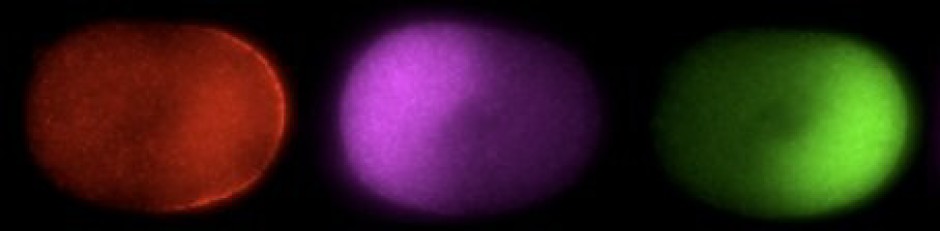
Scientific research is often slow and frustrating, but it is punctuated by the excitement of discovery. I experienced one such moment when I first saw these key microscopy images from my Ph.D. research, which I share here.
For my graduate work I investigated how a single cell, the egg, gives rise to a complex organism. My colleagues and I studied this question in the embryo of C. elegans, a tiny roundworm. We identified proteins that help set up the identity of the anterior and posterior structures.
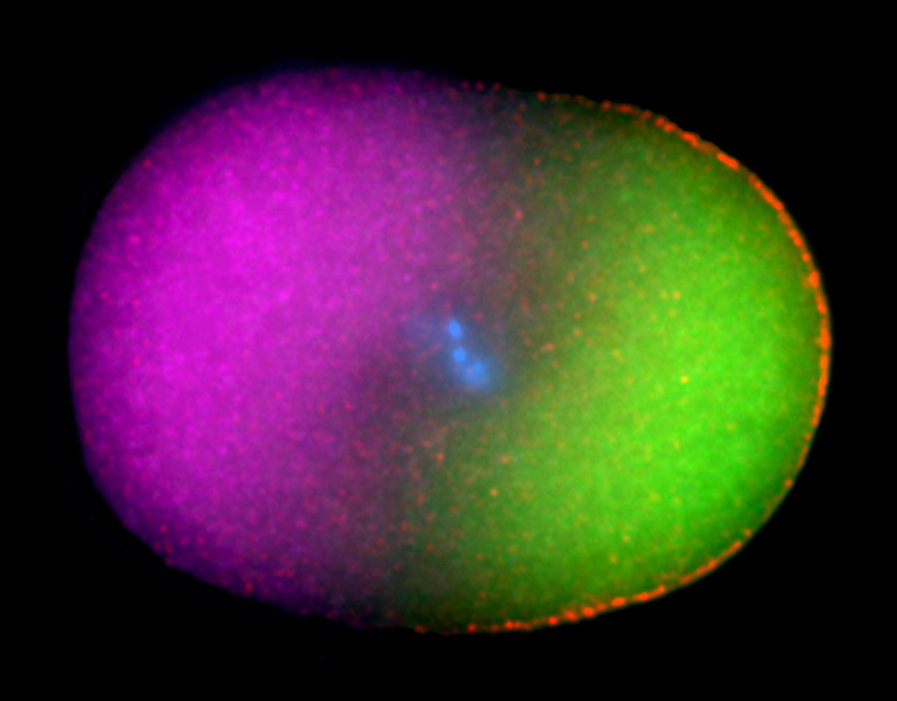
Shown are images of the one-cell embryo shortly after fertilization.

Orange (PAR-2): The PAR-2 protein localizes to the posterior perimeter of the embryo. PAR-2 helps set up where other proteins appear.
Magenta (MEX-5): The MEX-5 protein appears in the anterior of the embryo. MEX-5 promotes the degradation of the green protein.
Green (PIE-1): PIE-1 instructs posterior cells to generate the germline — the tissue that gives rise to sperm and eggs.
These images were taken using fluorescent tags that light up the relevant proteins. PIE-1 and MEX-5 were discovered by my colleagues and me in the lab of James Priess at Fred Hutchinson Cancer Center, where I earned my Ph.D.
Below: All three proteins together — PAR-3, MEX-5, and PIE-1. DNA is blue.

C. elegans, from the two cell stage to a larva. (Image by Bruce Draper)
Publications in peer-reviewed journals: Collectively, this research has been cited more than 750 times.
Ka Ming Pang, Takao Ishidate, Kuniaki Nakamura, Masaki Shirayama, Chris Trzepacz, Charlotte Schubert, James R. Priess and Craig C. Mello. The minibrain kinase homolog, mbk-2, is required for spindle positioning and asymmetric cell division in early C. elegans embryos. Developmental Biology (2004).
Charlotte Schubert, Rueyling Lin, Corry J. de Vries, Ronald H. Plasterk, and James R. Priess. Mex-5 and mex-6 function to establish soma/germline asymmetry in early C. elegans embryos. Molecular Cell (2000).
Christina Tenenhaus, Charlotte Schubert, Geraldine Seydoux. Genetic requirements for transcriptional silencing and PIE-1 localization in the embryonic germ lineage of C. elegans. Developmental Biology (1999).
Craig C. Mello, Charlotte Schubert, Bruce Draper, Wei Zhang, Robert Lobel and James R. Priess. The PIE-1 protein and germline specification in C. elegans embryos. Nature (1996).
Minireviews discussing my research
Ken Kemphues. PARsing embryonic polarity. Cell (2000).
Bruce Bowerman. Embryonic polarity: Protein stability in asymmetric cell division. Current Biology (2000).
 Charlotte Schubert